Tag Archives: Fulton County

Luther Judson Price-Atlanta, Georgia

The Price House

I owe this post to my two friends, Victoria and Ann. Both had shared photos of Luther Price’s house and said it was being restored. This Old House assisted with the restoration. I adore this house and am glad it got the attention it deserved. A restored photo of the home is below.

Luther J. Price

Luther Price was a shopkeeper and the first appointed Black postmaster of South Atlanta. He was also arrested for furnishing Black citizens guns and ammunition during the 1906 Atlanta Race Massacre.

He and his wife, Minnie, lived above the store with their children until they decided to move just down the street on Gammons Street.

The Morse Building
Morse can be seen under one of the power lines with what looks to be the date of 1906. I am uncertain what the other date is.

Victoria was the one who asked why the building was called Morse. I delved into census records to see if I could determine the reason why. Well, Albert Morse and his family lived right behind the store. They lived next to each other according to the 1900, 1910, 1920, and 1930 census records. Additionally, Morse is listed as a postal clerk. Since the 1890 Census Records were lost to fire, it is unknown whether the families knew each other before 1900 and who moved to the area first.

Morse House

The Morse house is still standing. In addition, Albert’s brother, Dr. George Skipworth Morse, was one of the first Black doctors to work for the Atlanta Public Schools. Both families were successful in their own right.

I hope to unravel more about the friendships between these two families.

Both families are buried in Southview Cemetery.

Luther J. Price Middle School is located close to where the Prices lived.

Eldren Bailey-Atlanta, Georgia

Eldren Bailey is seated in front of the sculptures in his front yard.

Eldren Bailey (1903-1987) was a sculptor known for large concrete sculptures. Born in Flovilla, Georgia, he moved to Atlanta at an early age. He first worked with the railroads, but he later became a mason. Many of his sculptures were brightly colored and adorned his front yard. Where he was most prolific though was helping many Black-owned funeral homes with the creation of grave markers.

Admittedly, I had always interpreted these as temporary markers, and for some families, they might have been true. For many, these markers are now permanent. Bailey’s markers differ from many of the other concrete markers seen in Black cemeteries.

Some of his larger pieces did end up in museums, but many of the sculptures seen in his front yard have disappeared.

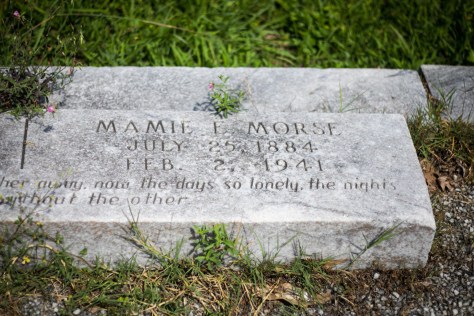
Bailey’s marker in Southview Cemetery. You can see a similar sculpture behind Bailey in the photo at the top.
This is likely a Bailey marker. It is in Morgan County. Haugabrooks was a Black owned funeral home.
Clayton County, Georgia
Fulton County
Fulton County
A marker that was later incorporated as part of a crypt design
Based on the handwriting and the floral pattern, I suspect this was done by Bailey, too.
$10 receipt for marker that my friend Liz Clappin found

For more reading, I suggest the following:

Black Art Story

Oakland Cemetery Blog Post

Books recommendations

Souls Grown Deep

South-View: An African American City of the Dead

Daniel Chester French’s “The Spirit of Achievement” at Westview Cemetery-Atlanta, Georgia

Known as “The Spirit of Achievement” or, more simply, “Achievement,” the Jesse Parker and Cora Best Taylor Williams memorial in Westview Cemetery illustrates the success of the Williamses, who relocated to Atlanta in 1900.

Cora and Jesse Parker Williams as depicted on the memorial

J. P. Williams built and ran the Georgia, Florida, and Alabama railway. Upon his death, Cora took over the management of the railroad. She ran the company until she passed. In her will, she asked that a hospital for women and children be built where their house once stood, at approximately 542 Peachtree Street. The hospital turned over management to Crawford Long Hospital, now Emory Midtown, in 1992. While the building no longer exists, the Jesse Parker Williams Foundation still exists and gives out health-related grants.

Image from the July 20, 1941 Atlanta Constitution.
This is an image from the March 16, 1941 Atlanta Constitution.

The memorial was created by sculptor Daniel Chester French and architect Henry Bacon. It’s listed as part of the Smithsonian’s Save Our Sculpture database.

Lincoln Cemetery-Atlanta, Georgia

Fulton County
The crypt of Reverend Doctor Ralph David Abernathy and Doctor Juanita Odessa Jones Abernathy is decorated with lipstick kiss marks. In addition to being a leading civil rights activist, Juanita was a successful Mary Kay salesperson and was noted for her lipstick color.

Founded in 1925 as Fairview Cemetery, Lincoln Cemetery is the final resting place for many notable Black Atlantans. Tiger Flowers, the renowned boxer, was one of the original benefactors to help develop the cemetery. The cemetery is over 100 acres, with many of the acres not yet developed.

Dr. Hamilton Holmes (1941-1995) desegregated the University of Georgia.
Tiger Flowers (1895-1927) was a renowned boxer, who passed away after surgery. His gravesite is behind the chapel. Before the chapel was built, his plot was in of the more prominent locations of the cemetery.
Leila Mae Williams (1912-2021) ran Leila’s Dinette on Fair Street. This article in the Atlanta Voice gives a good summary all of her accomplishments.
Reverend Hosea L. Williams, Sr. (1926-2000), the noted civil rights activist, rests at Lincoln.
W. A. Scott, the founder of Atlanta Daily World, was murdered outside his home in 1934. His murderer was never caught.
One of the many sculptures that dot the landscape at Lincoln.

Bethel Primitive Baptist Church-East Point, Georgia

Fulton County

Built in the late 1800s, the Bethel Primitive Baptist Church is located in East Point. The town was founded in 1870, so it is believed this is one of the first churches built in the area. There is a small cemetery behind the church. The lot is enclosed by a chain link fence, so I was unable to explore the cemetery. The church was partially restored and stabilized in 2011.

Hank Aaron at South-View Cemetery-Atlanta, Georgia

Fulton County
1934-2021