William Burroughs (Burrows) Smith was one of the wealthiest men in Charleston. He built his fortune as a cotton trader. When he died, he stayed in the receiving vault for two years while the pyramid designed by Edward Jones was built.
The Georgia School of Technology built the doors. During this time, Georgia Tech ran a contract shop where they would build items to specifications. These doors cost $300 to build. This shop only lasted until 1896.
The entryway illustrates several different symbols. The upside-down torches represent a “life extinguished. The hourglass at the top of the door represents time is ending. The wings combined with an hourglass means that our time is fleeting.
The stained glass window that can be seen through the windows in the doorAnother view of the sideThe view of the back side
The Historic American Building Survey was commissioned to create the architectural drawings of the Mausoleum.
Mt. Sumach Baptist Church is located in the hills of the Georgia Mountains near the Tennessee State line. The church’s graveyard is typical of many rural church cemeteries. There are a mixture of modest headstones. Additionally, there are a handful of vernacular markers. Two of these markers are the “head and shoulder” markers, which I usually see made out of wood. The pink marble marker is likely made from Tate, Georgia pink marble.
The grey granite marker says “MRA.” I am not sure what these two markers together mean.This is a typical Victorian marker which symbolizes the curtains are closing.The head and shoulders marker of Jackson Columbus Hooker, who only lived for one day. There was no visible name on this marker.While I suspect this marker was a commercially made marker, I liked that it had a myriad of colors.
San Sebastian and Pinehurst Cemeteries are located in West St. Augustine on Pearl Street. The two cemeteries are next to each other and are stated to be among the oldest Black cemeteries in the state of Florida. There is conflicting information on whether the cemeteries began before or after the Civil War.
The cemeteries contain a mixture of commercial and vernacular headstones, along with military ones. Additionally, there are mementos left on many graves. Everything from conch shells to dolls is scattered throughout.
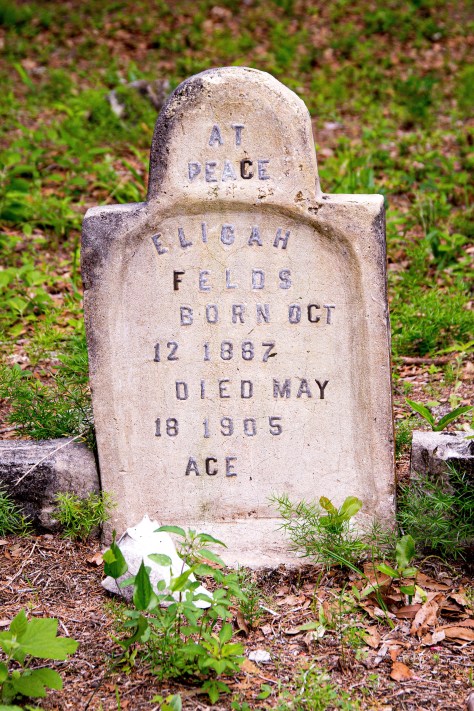
Mr. James Jones Remembrance of his daughter Elizabith. Aslapp. Edwin Mansell (1947-1999). This is one of the newer vernacular headstones I’ve seen. It uses tile which is a common material in handmade markers.I do not know what this stands for.Bessie R. James, 1883-1913Lewis Mickell, 1872-1915Elisah Felds, 1887-1905The name is hard to read, but the Masonic symbol is still visible.Ellen Simmons, d. 1910. This marker resembles an Angel.One of the many concrete crosses in the cemetery.Victorian grave markers heavily influence this marker.
There is no truth that carved chains on a headstone mean someone is born into slavery. Most chains represent the fraternal organization Fraternal Order of the Independent Order of the Odd Fellows. They are frequently joined with the letters “ F L T,” which stands for “Friendship, Love, Truth.”
I read several journal articles about the documentation of slave and Black cemeteries, and there was no mention that markers with chains meant someone was born into slavery. What is consistently mentioned are broken dish ware, clocks, shells, and different plants.
A circle of chains, broken or unbroken, can represent death or hope respectively.
Willie Whitted, 1879-1917. This is one of several Odd Fellows markers in the cemeteries. This person was born after the end of slavery.
This cemetery shared two borders with the all-white cemetery, Evergreen Cemetery.
When I first fell in love with cemeteries, I was always looking for impressive Victorian influenced markers. While I still love them, my interest has expanded to document vernacular markers. Folk art in headstones always interests me. I always wonder about the person being memorialized and the person who made the marker. The makers are often lost to history.
Close up of the marks on the Eliza Joiner Bullington. The marker’s inscription says, “MRS ELIZA WIFE OF REV R BULLIN GTON BORN AUG THE EIGHTH 1839 & DIED JULY THE 4 1884 THY HAND GOD DOTH SAVE 🌟 ME AND THE STAR OF THY HEAVENS DOTH GIVE LIGHT”Carear Bell Bullington (1886-1887)
The Joiner Cemetery sits on the edge of farmland. Outside of traditional markers that can be seen in any cemetery, there are several folk art headstones where a sawtooth pattern can be seen. The letter stamping is all very similar.
The sawtooth and diamond pattern was an interesting addition to the crypt.
As many of the markers are in poor condition, it’s important that these headstones are documented before they are lost forever.
Bessie Joiner marker which has been stabilized.Susan Carr, (1861-1881)Sabra Mims, (1846-1896)A collection of markers with no names or initials likely indicating children who have passed away.
Originally the home of Alpine Presbyterian Church, the Alpine Community Church in Menlo, Georgia, is located in the northwest Georgia mountains. The church was built in 1853. The cemetery contains markers that represent the long history of the church with a number of Victorian and more modern markers.
R. A. McWhorter family plot markerMary Knox, 1886-1889Thomas Knox, 1831-1882, has a marker made of zinc, also known as a zinkie.
Started in 1853, Catholic Cemetery was developed after leaders in the Catholic Diocese asked that there be a Catholic section in Laurel Grove North Cemetery, and their request was denied. After the cemetery opened, many remains were moved from Colonial Park Cemetery to here. Along with the remains, many of the stones were moved, too.
Marker for siblings, John Jasper, aged 11 days, and Mary Frances Rourke, 1874-1880.Eugene Battle-1901-1912-His epitaph reads “drowned March 14, 1912. A victim of play.”
Sherman’s troops used the cemetery as an encampment area. Many markers were damaged, and the ironwork was used to build fortifications.
Francis Bohan-1871-1900-I love the relief details spell out Frank.
This is an overlooked cemetery when people think of the must-see cemeteries in Savannah. There are several grand Victorian markers. There’s at least one John Walz of “Little Gracie” fame.
Prince-He loved his master. This is a rare marker to a pet in a “human” cemetery. A Confederate monument dedicated to the service of the “Irish Jasper Greens.”Rose (1858-1881) and Richard (1855-1882) Roe
Websites store cookies to enhance functionality and personalise your experience. You can manage your preferences, but blocking some cookies may impact site performance and services.
Essential cookies enable basic functions and are necessary for the proper function of the website.
Name
Description
Duration
Cookie Preferences
This cookie is used to store the user's cookie consent preferences.